


Just two more days to pre-register for the program this Thursday at Bentley College, the grand finale of 2005 meetings. We have a very strong panel of speakers and interesting exhibitors.Copyright (c) 2005 Connective Associates, except where otherwise noted.Please join us for this view of "Leveraging Knowledge through Collaboration." The speakers will share how they have made an impact through practical collaborative practices. Speakers: Eric Wilson, President, Brane space LLC; Kenneth Bruss, HDA Consulting, Changing the Way New Products are Developed – Using Collaboration Tools to Improve ROI; Jean Tatalias, The MITRE Corporation, Connecting People and Supporting Collaboration; Bruce Hoppe, Connective Associates, Disruptive Collaborative Innovation; Jeffrey Govendo, the Innovative Edge, Achieving Real Collaboration through Co-invention (an interactive exercise).
When: December 15, 8:30am - 5pm
Where: Bentley Collage, the Adamian Center Commons
Cost: $40 (pre-registered), $50 (walk-in)
Details and Registration: More Details: http://www.kmforum.org/bentley_events.htm
If I don't see you on Thursday, please have a safe, healthy and peaceful season of celebrations.Lynda
Wednesday, 14 December 2005
Monday, 12 December 2005
 Interesting ideas of 2005 include
- Consensual interruptions (your cell phone interrupts our conversation only if I grant permission)
- Do-it-yourself cartography (aka mash-ups)
- Fleeting relationships
- Folksonomies
- Open-source reporting
- Trust spray (!!!)
Copyright (c) 2005 Connective Associates, except where otherwise noted.
Friday, 9 December 2005
Yahoo launched a service called Answers on Thursday that invites people to ask questions, and then lets other visitors answer them. This isn’t explicit search—it’s Yahoo’s attempt at tapping into a community’s collective knowledge to dig out information.
 Neat! Now think about combining Yahoo Answers with a bit of text analysis, CiteSeer technology, and perhaps a touch of eBay--next thing you know you'll have some serious answers to your questions.
Copyright (c) 2005 Connective Associates, except where otherwise noted.
Wednesday, 7 December 2005
Something about this metric rubs me the wrong way. I participate in a wide variety of groups, and I like to volunteer for things like "hospitality" and "registration." I
 get to introduce myself to lots of people that way. Take a look at this detail of my business introduction network, and notice all the red nodes. Each of those is a different group I participate in where I have met business colleagues. Uzzi and Dunlap would suggest that even when I work the registration desk for one of these red nodes, I am subconsciously selecting people similar to me every time I exchange business cards. When I follow up and get introduced by my new colleagues to their colleagues, then Uzzi and Dunlap suggest I am more likely to free myself from my unstoppable urge to "homophilize."
Uzzi and Dunlap are probably right, but I wish they talked more about how networks grow from the groups we participate in. Instead, readers must turn to the somewhat more scholarly article, "Where do social relations come from?" which was published in the most recent issue of Social Networks. The author does a careful analysis of just how many relationships typically from from "circles" (group membership) versus "sociability" (introductions through others) and finds 59% arise through circles.
Copyright (c) 2005 Connective Associates, except where otherwise noted.
Tuesday, 6 December 2005
 assembed a nice academic bibliography on social network analysis, which includes a form at the bottom so that anyone can add new entries. He also maintains a comprehensive list of network visualization software.
I first encountered Jonathon through his paper (co-authored with Rob Cross) "Structural properties of work groups and their consequences for performance," which you can request from Cummings here. This research reveals a negative relationship between heirarchical team structure and performance in complex non-routine tasks, over 182 small work groups in a global service organization.
Copyright (c) 2005 Connective Associates, except where otherwise noted.
Friday, 2 December 2005
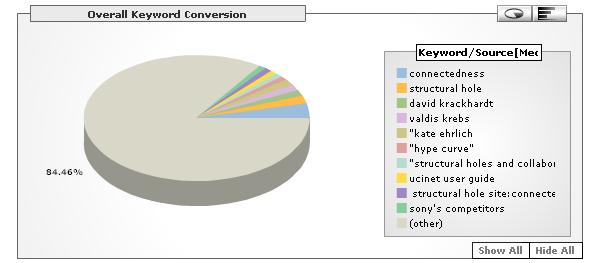 Within the subset of commonly used keywords above, notice how many are names of other people.
In my blogging practice, I have found writing about my fellow social networking enthusiasts to be beneficial on many levels. It's a good discipline to keep me informed on what's happening, and prevents me from reinventing the wheel. It's also a great way to build relationships with these esteemed colleagues, who are generally good at filtering out unwanted attention, but still appreciate concisely thought-out posts on their work. And, as the above graphic shows, name-dropping on Connectedness attracts hits. By comparison, notice how often people find Connectedness by Googling "Bruce Hoppe."
The problem with name-dropping is its superficiality. Or is that really a problem? The other day David Krackhardt gave me a call and we commiserated on this question. To get the gist of our conversation, I recommend you read Martin Kilduff and David Krackhardt's paper, "Bringing the individual back in: A structural analysis of the internal market for reputation in organizations." The abstract includes this provocative quote:
We found, as predicted, that being perceived to have a prominent friend in an organization boosted an individual's reputation as a good performer, but that actually having such a friend ... had no effect.Of course, as long as people know you have a prominent friend, then actually having that prominent friend doesn't hurt either. That's why I still appreciate gestures like Steve Borgatti's link to Connectedness from his Managerial Network Analysis page:
 Copyright (c) 2005 Connective Associates, except where otherwise noted.
Thursday, 1 December 2005
"The big boys, corporations and governments, have far more reason to be interested and concerned this time," said Eben Moglen, general counsel to the Free Software Foundation, which holds the license, commonly known as the G.P.L.
The process will also be closely watched for how the new G.P.L. will take account of software patents, which have exploded among proprietary software developers since 1991, the last time the license was revised.
One person who has watched the open source community especially closely is my colleague Bob Wolf  at BCG. He published an outstanding analysis of how open source works in the July-August 2005 Harvard Business Review. Click on the title page at right to read it.
Bob and his coauthor Philip Evans compare Linux developers to the Toyota Production System and draw fascinating conclusions on what big business can learn from rebel hackers. Jack Vinson at Knowledge Jolt gave a good summary of these lessons back when the article was originally published. To Jack's comments I add that the HBR article does a nice job of distinguishing two kinds of trust: (1) Trust based on reputation, and (2) Trust based on reciprocity. Open source depends more on the first. I may not ever repay your favor directly (a requirement of reciprocity) but if I screw you then the word spreads so fast that my reputation across the entire community will be ruined. So for the sake of their reputations, group members all play nice, develop great trust for each other, and thereby enjoy very low "transaction costs" (e.g., fewer contracts).
Copyright (c) 2005 Connective Associates, except where otherwise noted.


