Connecte Dness

  • Subscribe to our RSS feed.
  • Twitter
  • StumbleUpon
  • Reddit
  • Facebook
  • Digg

Saturday, 21 October 2006

Dilbert uses SNA to improve productivity

Posted on 13:35 by Unknown
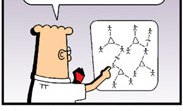
Thanks to Drew Phillips for clipping last Sunday's Dilbert strip, which features SNA.


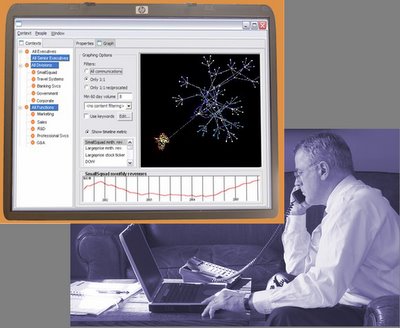
Somewhat reminiscent of another image in my archives.

This work is licensed under a Creative Commons Attribution-ShareAlike 2.5 License and is copyrighted (c) 2006 by Connective Associates except where otherwise noted.

Read More
Posted in | No comments

Monday, 16 October 2006

See change in your own organization

Posted on 05:05 by Unknown
After a several-week blogging hiatus, Connectedness shows signs of life this Monday morning with its first YouTube video, produced in collaboration with See Change, Inc. The following excerpt shows Robert, a program manager, putting his new leadership skills to work on behalf of his team, which includes one person unfortunately known to all as the "VAP" (Very Annoying Person).


This video is my overdue response to questions raised by the Accenture demo video from a few months ago. That demo video launched a thread discussed at some length on the Value Network Google discussion group. I found it interesting how that thread focused largely on the challenges of enterprise-wide data-mining. To that thread I would add the equally significant observation that anyone can now create and publish his own network stories in video form.

This work is licensed under a Creative Commons Attribution-ShareAlike 2.5 License and is copyrighted (c) 2006 by Connective Associates except where otherwise noted.

Read More
Posted in | No comments

Wednesday, 13 September 2006

Those who can't blog, teach blogging

Posted on 02:41 by Unknown
Connectedness is on a reduced schedule these days. I am one week into teaching "Online Social Networks" at Boston University. It is fun--and a ton of work--to bring a new concept for a college course to life. Add to that the fact that I am completely new to BU and that my class depends on a mini-fiefdom of TFs and graders that I have to organize... and you get me stealing some time from my workday by blogging at 5:30am.

To compensate for my reduced blogging, I am having my students blog for credit. They are going to complement that with basic web programming and some introductory social network analysis.

We started the social network analysis on the very first day of class. I had my students pair off and interview each other about their Internet preferences (PC vs Mac, IE vs Firefox, etc). You can see the resulting map of who paired with whom at right.

The map of pairings by itself is not so interesting, but it got more interesting at the end of class when I invited everyone to stand up and make an impromptu party at the front of the class. We took note of who clustered with whom. Below you can see red dots representing each of the 13 party clusters. Blue dots connected to red dots are students in the party clusters. Blue dots connected to blue dots are interview pairs from earlier in class.

Showing students a map of how they connect with each other on the very first day of class provides a fun and meaningful springboard to consider how their blogs and other websites will be connecting later in the semester.

On another topic... if you're near Boston, come hear "KM meets OD" co-presented by Patti Anklam and me, Thursday evening Sept 14, hosted by the Mass Bay OD Learning Group.


This work is licensed under a Creative Commons Attribution-ShareAlike 2.5 License and is copyrighted (c) 2006 by Connective Associates except where otherwise noted.

Read More
Posted in | No comments

Tuesday, 5 September 2006

The New Tastemakers (NY Times)

Posted on 10:38 by Unknown
Today I am very busy preparing my first ever lecture at Boston University, where I am about to teach Online Social Networks under the guise of "CS-103: Introduction to Internet Technologies and Web Programmming."

Conveniently, last Sunday's NY Times Arts & Leisure section supplied me with my lecture material. Check out this wonderful front-page article on how traditional music experts (FM radio program managers, record label talent artists) are losing power and influence to online services.

Strangely, the front page graphic features a social network map, even though Pandora.com, the most prominent online music service in the article, is not really driven by social network technology. See The Music Genome Project for more.

This work is licensed under a Creative Commons Attribution-ShareAlike 2.5 License and is copyrighted (c) 2006 by Connective Associates except where otherwise noted.

Read More
Posted in | No comments

Tuesday, 29 August 2006

The Community of Practice heard round the world

Posted on 05:01 by Unknown
The Connectedness staff is back at the blog after a wonderful summer vacation. While resting at the Omega Institute, I got a hoot reading Gordon Wood's pithy history, The American Revolution. I have been addicted to founding-father bios for a few years now. Reading this high-level overview of the period gave me new clarity on the hook of my addiction: The American Revolution is arguably the greatest organizational development case study of all time. This realization put a bit of a damper on the idea that I was actually vacationing, but I enjoyed the epiphany nonetheless.

There are parts of Wood's historical analysis that seem aimed more at our current administration than its forebears. Writing after the U.S. invasion of Afghanistan but before Iraq, Wood says:
British disadvantages [in 1775] were immense and perhaps overwhelming.... A well-trained army might have been able to to conquer the American forces, but... America itself was unconquerable. The great breadth of territory and the wild nature of the terrain made conventional maneuverings and operations difficult and cumbersome. The fragmented and local character of authority in America inhibited decisive action by the British. There was no nerve center anywhere whose capture would destroy the rebellion. The British generals came to see that engaging Washington's army in battle ought to be their main objective; but, said the British commander in chief, they did not know how to do it, "as the enemy moves with so much more celerity than we possibly can."
For more on how Washington's tactics of 1776 are being used today by Hezbollah, Al Quaeda, and other social action groups, see "Networks, Netwars, and the Fight for the Future," which was originally recommended to me by Kate Ehrlich. When you read this paper, savor the irony of its opening line:
Netwar is an emerging mode of conflict in which the protagonists use network forms of organization, doctrine, strategy, and technology.... The practice of netwar is well ahead of theory, as both civil and uncivil society actors are increasingly engaging in this new way of fighting.
This work is licensed under a Creative Commons Attribution-ShareAlike 2.5 License and is copyrighted (c) 2006 by Connective Associates except where otherwise noted.
Read More
Posted in | No comments

Friday, 4 August 2006

Online identity verification and two-sided networks

Posted on 04:24 by Unknown
Yesterday's Wall Street Journal had this on the top of its front page: "Building Trust Into Web Identities." When we interact online, it's increasingly important to know who is on the other side of the screen. There are many services emerging that provide various forms of ID verification, which are covered nicely in the article. The article goes just deep enough to give a quick nod to the forward-looking Higgins Project, which is being led by Parity Communications (mentioned here yesterday) with support from IBM and Novell.

It's important to note that ID-verification services are fighting to attract two completely different sets of users. They must enlist websites to license their technology and they must enlist users to register for IDs. Both sides are absolutely essential to any successful ID-verification service.

Several days ago I lunched with Marshall Van Alstyne as he explained this pervasive two-sided business phenomenon, which is old as the hills but only recently something specifically named and studied by economists. Marshall and his colleagues call it a "two-sided network." Stay tuned for a lot more popular business press on this topic in the near future. Meanwhile, you can see Geoffrey Parker's home page for his paper "Two-Sided Network Effects," co-authored with Marshall.

This work is licensed under a Creative Commons Attribution-ShareAlike 2.5 License and is copyrighted (c) 2006 by Connective Associates except where otherwise noted.

Read More
Posted in | No comments

Thursday, 3 August 2006

Visualizing organizational change

Posted on 10:36 by Unknown
Social network analysis is often discussed as a way to see "how an organization really works." Less often do people acknowledge that "how an organization is changing" is often even more important than "how it is working." SNA researchers are hard at work developing ways of measuring change (typically under the name of "longitudinal studies"). Unfortunately, in a field that already suffers from interesting but hard-to-use technology, longitudinal methods of SNA are even more difficult to grasp and apply than their static snapshot counterparts (by a wide margin).

All that makes it even more impressive that the Accenture Institute for High Performance Business, led by Bob Thomas, has produced a relatively accessible dramatization of how real-time dynamic SNA can be a powerful business tool in the not-too-distant future.

I had the privilege of creating this seven-minute Flash video for Bob, in collaboration with Sarah Maloney of Accenture, Paul Trevithick and Mary Ruddy of Parity Communications and Barry O'Brien of North Shore Communications. You can see our handiwork here.
This work is licensed under a Creative Commons Attribution-ShareAlike 2.5 License and is copyrighted (c) 2006 by Connective Associates except where otherwise noted.

Read More
Posted in | No comments
Newer Posts Older Posts Home
Subscribe to: Posts (Atom)

Popular Posts

  • Happy, or at least healthy endings
    Yesterday was the 8th anniversary of my first Connectedness post , but it's been 3 years since I was even semi-active in this space. One...
  • Technology, sociology, and networks
    Behind the scenes at Connectedness , I have been talking to more computer scientists and fewer sociologists, relative to previous months. I ...
  • Social capital of twenty-first-century leaders, by Daniel Brass and David Krackhardt
    How do effective leaders manage relationships with their team members? Dan Brass and David Krackhardt put this question in context: "...
  • Weekend edition: SWMSNA seeks SWF
    It is the great tradition of science that our biggest discoveries often emerge from the smoldering ashes of our most disappointing failures....
  • Structural equivalence: related tags in social bookmarking
    In my " Holy Trinity of Network Power ," structural equivalence is conceptually the most obscure. But practically speaking, it is ...
  • Weekend Edition: Flesh-Eating Zombies
    As part of my final preparations for Sunbelt XXV , I watched a dramatic treatment of infection networks. 28 Days Later is the modern-day st...
  • What is My Network Value Worth?
    Pedro Domingos and Matt Richardson analyze the power of viral marketing in their paper, " Mining the Network Value of Customers ....
  • Sunbelt Goes to the Oscars
    I am dried off from the record-setting rains of Sunbelt XXV and ready to start reflecting... about this weekend's big Oscar hoo-ha (sor...
  • Searchable leadership networks bibliography
    Our new Link-to-Results site features a categorized searchable bibliography . Of all the pages on the site, this one has generated by far ...
  • Process networks in medical research
    I tripped over this interesting post by John Hagel : " Process networks in medical research ," in which he describes the Myelin Re...

Blog Archive

  • ▼  2012 (1)
    • ▼  June (1)
      • Happy, or at least healthy endings
  • ►  2010 (3)
    • ►  June (2)
    • ►  May (1)
  • ►  2009 (22)
    • ►  December (1)
    • ►  September (2)
    • ►  August (2)
    • ►  July (1)
    • ►  June (5)
    • ►  May (4)
    • ►  March (2)
    • ►  February (4)
    • ►  January (1)
  • ►  2008 (36)
    • ►  December (3)
    • ►  November (2)
    • ►  October (1)
    • ►  September (6)
    • ►  August (4)
    • ►  July (2)
    • ►  June (8)
    • ►  May (4)
    • ►  April (3)
    • ►  February (1)
    • ►  January (2)
  • ►  2007 (42)
    • ►  December (1)
    • ►  November (1)
    • ►  October (2)
    • ►  September (6)
    • ►  August (6)
    • ►  July (5)
    • ►  June (8)
    • ►  May (4)
    • ►  March (3)
    • ►  February (1)
    • ►  January (5)
  • ►  2006 (63)
    • ►  December (4)
    • ►  October (2)
    • ►  September (2)
    • ►  August (3)
    • ►  July (7)
    • ►  June (10)
    • ►  May (10)
    • ►  April (4)
    • ►  March (8)
    • ►  February (6)
    • ►  January (7)
  • ►  2005 (136)
    • ►  December (11)
    • ►  November (13)
    • ►  October (11)
    • ►  September (9)
    • ►  August (10)
    • ►  July (10)
    • ►  June (10)
    • ►  May (12)
    • ►  April (13)
    • ►  March (15)
    • ►  February (9)
    • ►  January (13)
  • ►  2004 (99)
    • ►  December (9)
    • ►  November (18)
    • ►  October (13)
    • ►  September (16)
    • ►  August (15)
    • ►  July (20)
    • ►  June (8)
Powered by Blogger.

About Me

Unknown
View my complete profile