Connecte Dness

  • Subscribe to our RSS feed.
  • Twitter
  • StumbleUpon
  • Reddit
  • Facebook
  • Digg

Tuesday, 23 June 2009

Twitter: timing is everything...?

Posted on 10:53 by Unknown
The majority of my clients and colleagues are using it, but I have not uttered the word until now: TWITTER. I was convinced to break my silence when I saw Time magazine: "How Twitter Will Change the Way We Live."

Here is my version of Time's story: Twitter does to texting what blogging did to email.

So let's get to the root of the matter: Texting. John Cassidy says it better than I can in the October 2008 New Yorker, "Thumbspeak: Is Texting Here to Stay?" Summary of Cassidy: We may be helplessly addicted to crackberries etc, but we are not addicted to typing words with numeric keypads. As soon as we all have QWERTY in our palms, we will then do away with the 140-character barrier and, with that, all the quirks that make txt msgs distinct from emails will quickly die a natural death.

If texting becomes indistinguishable from emailing (grant me that hypothetical just for a moment) how then will Tweeting differ from blogging? I am curious.

[The editor pauses... almost publishes the post... then takes a phone call from a colleague with more Twitter stories. A change of heart occurs.]

No, wait, I have glossed over something fundamental: Timing. Words have rhythm. Even if my version of the Twitter story is technically true (which I think it is), it misses the whole timing thing. That is a big deal, experientially if not technically.

Comments, anyone?

This work is licensed under a Creative Commons Attribution-ShareAlike 3.0 License and is copyrighted (c) 2009 by Connective Associates LLC except where otherwise noted.

Read More
Posted in | No comments

Monday, 22 June 2009

Beginner's mind and collective intelligence

Posted on 06:49 by Unknown
It's five years to the day since the first post on Connectedness.

An unspoken theme of those five years deserves recognition today: Beginner's Mind. I heard the phrase last September, when Fred Small preached his very first sermon as the new senior minister at my church.

Without Fred's flair for story-telling, Wikipedia still does a good job of explaining beginner's mind:
"Beginner's mind ... refers to having an attitude of openness, eagerness, and lack of preconceptions when studying a subject, even when studying at an advanced level, just as a beginner in that subject would. The term is especially used in the study of Zen Buddhism and Japanese martial arts.

"The phrase was also used as the title of Zen teacher Shunryu Suzuki's book: Zen Mind, Beginner's Mind, which reflects a saying of his regarding the way to approach Zen practice: In the beginner's mind there are many possibilities, in the expert's mind there are few."
My fascination with beginner's mind often puts me in a bind: In my consulting and my teaching, I am usually invited to take the role of expert, the perspective that will reduce the confusion of many possibilities to the simplicity of the few and the best. Rarely am I invited to help experts take off the focused blinders of their hard-won experience.

Beginner's mind is easily left behind and forgotten. For example, consider that exemplar of communal beginner's knowledge: Wikipedia. The scope and accuracy of this site are deservedly celebrated: Rob Laubacher, Executive Director of the MIT Center for Collective Intelligence, notes that Harvard medical school students prepare for exams using Wikipedia. But where do beginners turn for an introduction to anatomy, once Harvard medical students have claimed Wikipedia as their study guide? I posed that question to Rob. He said it was the first time he had heard the notion that Wikipedia was evolving into a collection of specialized expert-driven beginner-unfriendly articles. We wondered if my experience of Wikipedia being advanced and not at all beginner-friendly was related to the topic my students most want to learn: Web technology.

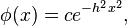
To a point, perhaps. As a case study of how Wikipedia takes a simple non-Web idea and moves it beyond the grasp of beginners, consider the notion of probability as introduced by Wikipedia and Encyclopedia Britannica. Within its first few paragraphs, before citing a single concrete example of probability (e.g., flipping a coin, rolling dice), Wikipedia asserts thatwhich is easy for them to say. And I mean that truly. Once you have mastered such notation, explaining probability with a language as imprecise as English is really hard. Yet English is the language spoken most often by American students. So where are they to turn? Read Britannica and see for yourself.

When Wikipedia introduces probability as is that what we mean by "collective intelligence," "working wikily," or "wikinomics"? Probably not. But you have to admit it makes sense for Wikipedia to explain probability to us in that way. Why should privileged experts with mastery of a valuable language such as probability theory make it easy for ignorant beginners to join them? The simplest answer is, "Because Encyclopedia Britannica pays them to." In conversations with Rob and others, I have heard of other sensible and even uplifting answers to this question. And so I hope that ignorant and expert alike may be blessed with Beginner's Mind.


PS: See James Surowiecki for a good argument that high-quality information requires high-quality compensation.

PPS: My last sustained post along these lines was this one, in reference to John Ziman's 1968 monograph Public Knowledge--An Essay Concerning the Social Dimension of Science, specifically in the chapter "Community and Communications."

This work is licensed under a Creative Commons Attribution-ShareAlike 3.0 License and is copyrighted (c) 2009 by Connective Associates LLC except where otherwise noted.

Read More
Posted in | No comments

Friday, 5 June 2009

Organizational network analysis utility: Unleashed

Posted on 08:53 by Unknown
Back in November 2005 I posted an organizational network analysis utility — a spreadsheet to help process network survey data and load it into network analysis software like UCINET (which is one of my faves, just behind NetDraw and Visone).

Since then, the spreadsheet has been available via email. But I confess that I have more than occasionally fallen behind in emailing copies to those who have requested. Sorry about that.

Now the spreadsheet is available by direct download from the Leadership Networks site here. No more waiting for emails from me.

Not coincidentally, I have been reading posts by Claire Reinelt about unleashing leadership networks — as opposed to sustaining them. Summarizing Ed O'Malley who directs the Kansas Leadership Center, Claire lists 7 practices for unleashing. The 3rd is "let go of the control."

In other words, it's time for me to stop being a bottleneck! Below is more information about the spreadsheet utility, copied from the original Nov 2005 post:
Organizational network analysis provides intuitively compelling pictures of how work really happens, giving us a handle on slippery intangibles that drive the future success of an enterprise.

Although this kind of intuitive analytical power has very wide appeal, its usefulness is limited right now by the unwieldy software tools currently available.

Deep down, making good simple network pictures is inherently complicated, but using network visualization software doesn't have to be. Progress is being made every day. See the newly updated list of SNA software in the right sidebar for some great examples. (And please let me know if I'm missing something.)

Even with the simplest of these tools, my non-technical clients often get hung up right away with the basic task of getting the data in. We power-users can easily forget how hard it was to build our first network, until we see someone else learning for the first time.

Here's an Excel spreadsheet utility my clients and I find helpful. I now make it freely available, in the hopes that more people will enjoy the benefits of seeing the big picture of the network perspective.

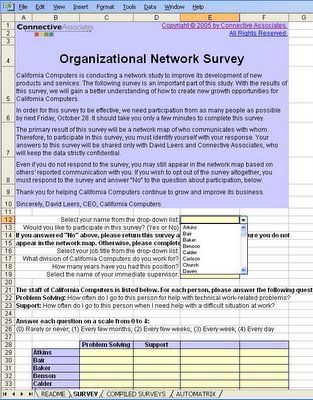
The spreadsheet includes three worksheets. One worksheet is the actual survey, which can be modified to suit the specific project. It automatically incorporates the names of the survey population into a drop-down list.
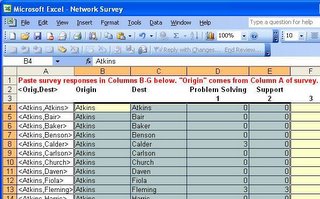
After distributing the survey via email, collected responses can be pasted in any order into a "compiled survey" worksheet:

Then an "automatrix" worksheet converts the compiled results into square matrices that can easily be pasted into available network analysis tools. The matrix calculator makes it easy to manage who opts in or out of the survey, and it provides access to multiple relationships.

If you'd like a copy of the spreadsheet, which includes a copy of a great California Computer case study (permission granted by David Krackhardt), you can download it here.


This work is licensed under a Creative Commons Attribution-ShareAlike 3.0 License and is copyrighted (c) 2009 by Connective Associates LLC except where otherwise noted.

Read More
Posted in | No comments

Wednesday, 27 May 2009

Searchable leadership networks bibliography

Posted on 04:38 by Unknown
Our new Link-to-Results site features a categorized searchable bibliography. Of all the pages on the site, this one has generated by far the most feedback. Those whose work we overlooked have been kind to let us know and share with us.

We attempted to synthesize many different fields of work in the bibliography (e.g., leadership development, business, sociology, mathematics). Rather than categorize our references according to their traditional fields, we categorized the references according to why we were interested in them:
  • Leadership Development
  • Performance & Innovation
  • Community & Social Change
  • Group Incentives
  • Evaluation
  • Social Capital
  • Social Networks
  • Network Building
  • Network Analysis
  • Software and Visualization
Click on each link above and you can see our list of references for that category.

Citing references, categorizing, naming things. These are essential to learning and yet get in the way too. I close with thoughts on naming things, quoting from the Tao Te Ching.

The Tao that can be told is not the eternal Tao.
The name that can be named is not the eternal name.
The nameless is the beginning of heaven and earth.
The named is the mother of ten thousand things.
Ever desireless, one can see the mystery.
Ever desiring, one can see the manifestations.
These two spring from the same source but differ in name; this appears as darkness.
Darkness within darkness.
The gate to all mystery.

--Lao Tsu, Translated by Gia-Fu Feng.

This work is licensed under a Creative Commons Attribution-ShareAlike 3.0 License and is copyrighted (c) 2009 by Connective Associates LLC except where otherwise noted.

Read More
Posted in | No comments

Tuesday, 26 May 2009

Leadership for a New Era

Posted on 13:10 by Unknown
"You cannot solve problems with the same level of consciousness that was used to create them."
--Albert Einstein

Leadership for a New Era is an initiative led by the Leadership Learning Community (LLC) with the mission to transform individuals and society by connecting the learning and practice of those who support leadership that is committed to promoting social and economic equity.

Claire Reinelt, Director of Research and Evaluation at LLC, says the initiative is focused on "contributing to a shift in our current leadership thinking from a primary focus on the individual to approaches that support leadership in the context of collective work, networks, communities and social movements...."

Today Claire invites you to share your leadership and learning. She posts on the Leadership Networks discussion forum:
"What do we know about leadership networks that others may not have considered or that they have a tendency to forget? As part of the Leadership for a New Era collaborative learning initiative, we want to share this wisdom with leadership programs and community initiatives, many of which seek to build social capital and network capacity. Here is what I came up with.
  • Successful networks are not sustained they are unleashed.
  • Remember that people are nodes in multiple networks.
  • Bridging across boundaries increases the probability of innovation.
  • Those on the periphery of a network offer pathways to new allies.
"What is your wisdom?"
I am especially fond of the first bullet! You can respond to Claire here.

PS: For extra credit, I will add this to Claire's question: In reference to the Einstein quote above, what different level of consciousness do we need to solve (as opposed to create) our problems? For example: higher or lower? Someday, perhaps, I will post on why I personally favor the "lower" path.

This work is licensed under a Creative Commons Attribution-ShareAlike 3.0 License and is copyrighted (c) 2009 by Connective Associates LLC except where otherwise noted.

Read More
Posted in | No comments

Friday, 22 May 2009

New resource on leadership networks

Posted on 07:23 by Unknown
Claire Reinelt and I have just turned our paper "SNA and the Evaluation of Leadership Networks" (to appear in Leadership Quarterly (Elsevier)) into a full-blown website where practitioners of leadership development can find and share resources: http://link-to-results.com. The site includes the paper, a tagged & searchable database of our bibliography, a discussion forum, case studies, and other resources related to leadership networks.

Below is one of the introductory pages on the site, "Kinds of Leadership Networks":


Leadership networks provide resources and support for leaders, and increase the scope and scale of impact leaders can have individually and collectively. We find it helpful to distinguish four types of leadership networks:
  • Peer leadership
  • Organizational leadership
  • Field-policy leadership
  • Collective leadership
Our choice to focus on these four types of networks grows out of our experience as consultants with clients who fund, run, and catalyze leadership networks. Often our clients are interested in using network mapping or other tools to increase the awareness of leaders about the power of networks, to further catalyze relationships and connections, and to strengthen the capacity of the network to act collectively. There is also growing interest in knowing what difference leadership networks are making.

Our leadership network classification framework is also influenced by the work of Borgatti and Foster (2003), Plastrik and Taylor (2006), among others. We compare these three frameworks with the tables below:

Our Framework
Type of Network Description of Network
Peer Leadership Network

Leaders who are connected through shared interests and commitments, shared work, or shared experiences. Leaders in the network share information, provide advice and support, learn from one another, and occasionally collaborate together.

Organizational Leadership Network

Leaders who connect to increase performance. Often these are informal connections joining people who are employees of the same organization, such as when an employee seeks advice from a colleague other than her supervisor.

Field-Policy Leadership Network

Leaders who have a shared commitment to influencing the world around them (e.g., the framing of a particular issue, underlying assumptions, and standards for how things get done). These networks make it easier for leaders to find common ground, mobilize support, and influence policy and the allocation of resources.

Collective Leadership Network

People who self-organize around a common cause. Network members exercise leadership locally and sometimes connect on a large scale. These networks may be driven by a desire to achieve a specific goal, or simply by the desire of each member to belong to something larger than oneself.

Borgatti and Foster approach networks with a more conceptual emphasis than ours. They present a very broad network paradigm within a two-by-two matrix. We highlight below how the four quadrants of their matrix correspond most closely to our framework of four types of leadership networks:

Borgatti and Foster (2003)

Goal used to explain network
Actor performance evaluation Properties of resource diffusion
Mechanism used to explain network Structural position of actors in network Structural Capital
(Organizational)
Environmental Shaping
(Field-Policy)
Flow of resources through ties Social access to resources
(Peer)
Contagion
(Collective)

Plastrik and Taylor's Net Gains handbook speaks directly to practitioners (network builders) seeking social change. Their framework also maps neatly onto ours:

Plastrik and Taylor (2006)

Connectivity Network
(Peer)
Alignment Network
(Organizational)
Production Network
(Field-Policy)
Definition
Connects people to allow easy flow of and access to information and transactionsAligns people to develop and spread an identity and collective value proposition
Fosters joint action for specialized outcomes by aligned people
Desired Network Effects
Rapid growth and diffusion, small-world reach, resilience
Adaptive capacity, small-world reach, rapid growth and diffusion
Rapid growth and diffusion, small-world reach, resilience, adaptive capacity
Key Task of Network Builder
Weaving-help people meet each other, increase ease of sharing and searching for information
Facilitating-helping people to explore potential shared identity and value propositionsCoordinating- helping people plan and implement collaborative actions

The fundamental goal of our framework is to help practitioners of leadership development - to explain when and how to use social network analysis as an evaluation and capacity-building tool.

All people who are dedicated to developing and supporting the emergence of leadership must understand how to create, develop, and transform leadership networks. We hope our work will inspire more evaluation research on leadership networks and on how to harness and use the power of social network analysis for the collective good.

This work is licensed under a Creative Commons Attribution-ShareAlike 3.0 License and is copyrighted (c) 2009 by Connective Associates LLC except where otherwise noted.
Read More
Posted in | No comments

Thursday, 14 May 2009

Student leadership: thank you Sidney Efromovich

Posted on 14:00 by Unknown
Collaborating with Nat Welch of CFAR has taught me the virtues of Found Pilots and the Campaign Approach to Change -- the progress you seek already exists as deviant behavior within the present moment.

I was "lucky" (I keep telling myself) to find lots of deviant behavior among my most recent cohort of students at Boston University. For example, the most popular student project featured a wonderfully deviant title: "Ben Timmins worked a ton, and all he got was this website."

My favorite found pilot was the unauthorized work of one Sidney Efromovich, BU '09, founder of the Hug Don't Hate Movement. Starting from day one, Sidney typed all my lectures into an encyclopedic set of Web pages. The whole semester -- every example I explained, every diagram I drew, every definition, equation, formula -- all of it Sidney not only included in his site but also improved in the process.

Having worked 3 years (a lifetime?) to develop a beginner-friendly and conceptually rigorous curriculum for the undocumented field of Web Science, I am very grateful to Sidney for so artfully, faithfully recording our spring 2009 improvisation on that theme. I am even more grateful to Sidney for giving me every artifact of his Web site as a parting gift. An honor and a privilege to have worked with you, Sidney!

This work is licensed under a Creative Commons Attribution-ShareAlike 3.0 License and is copyrighted (c) 2009 by Connective Associates LLC except where otherwise noted.

Read More
Posted in | No comments
Newer Posts Older Posts Home
Subscribe to: Posts (Atom)

Popular Posts

  • Happy, or at least healthy endings
    Yesterday was the 8th anniversary of my first Connectedness post , but it's been 3 years since I was even semi-active in this space. One...
  • Technology, sociology, and networks
    Behind the scenes at Connectedness , I have been talking to more computer scientists and fewer sociologists, relative to previous months. I ...
  • Social capital of twenty-first-century leaders, by Daniel Brass and David Krackhardt
    How do effective leaders manage relationships with their team members? Dan Brass and David Krackhardt put this question in context: "...
  • Weekend edition: SWMSNA seeks SWF
    It is the great tradition of science that our biggest discoveries often emerge from the smoldering ashes of our most disappointing failures....
  • Structural equivalence: related tags in social bookmarking
    In my " Holy Trinity of Network Power ," structural equivalence is conceptually the most obscure. But practically speaking, it is ...
  • Weekend Edition: Flesh-Eating Zombies
    As part of my final preparations for Sunbelt XXV , I watched a dramatic treatment of infection networks. 28 Days Later is the modern-day st...
  • What is My Network Value Worth?
    Pedro Domingos and Matt Richardson analyze the power of viral marketing in their paper, " Mining the Network Value of Customers ....
  • Sunbelt Goes to the Oscars
    I am dried off from the record-setting rains of Sunbelt XXV and ready to start reflecting... about this weekend's big Oscar hoo-ha (sor...
  • Searchable leadership networks bibliography
    Our new Link-to-Results site features a categorized searchable bibliography . Of all the pages on the site, this one has generated by far ...
  • Process networks in medical research
    I tripped over this interesting post by John Hagel : " Process networks in medical research ," in which he describes the Myelin Re...

Blog Archive

  • ▼  2012 (1)
    • ▼  June (1)
      • Happy, or at least healthy endings
  • ►  2010 (3)
    • ►  June (2)
    • ►  May (1)
  • ►  2009 (22)
    • ►  December (1)
    • ►  September (2)
    • ►  August (2)
    • ►  July (1)
    • ►  June (5)
    • ►  May (4)
    • ►  March (2)
    • ►  February (4)
    • ►  January (1)
  • ►  2008 (36)
    • ►  December (3)
    • ►  November (2)
    • ►  October (1)
    • ►  September (6)
    • ►  August (4)
    • ►  July (2)
    • ►  June (8)
    • ►  May (4)
    • ►  April (3)
    • ►  February (1)
    • ►  January (2)
  • ►  2007 (42)
    • ►  December (1)
    • ►  November (1)
    • ►  October (2)
    • ►  September (6)
    • ►  August (6)
    • ►  July (5)
    • ►  June (8)
    • ►  May (4)
    • ►  March (3)
    • ►  February (1)
    • ►  January (5)
  • ►  2006 (63)
    • ►  December (4)
    • ►  October (2)
    • ►  September (2)
    • ►  August (3)
    • ►  July (7)
    • ►  June (10)
    • ►  May (10)
    • ►  April (4)
    • ►  March (8)
    • ►  February (6)
    • ►  January (7)
  • ►  2005 (136)
    • ►  December (11)
    • ►  November (13)
    • ►  October (11)
    • ►  September (9)
    • ►  August (10)
    • ►  July (10)
    • ►  June (10)
    • ►  May (12)
    • ►  April (13)
    • ►  March (15)
    • ►  February (9)
    • ►  January (13)
  • ►  2004 (99)
    • ►  December (9)
    • ►  November (18)
    • ►  October (13)
    • ►  September (16)
    • ►  August (15)
    • ►  July (20)
    • ►  June (8)
Powered by Blogger.

About Me

Unknown
View my complete profile