Connecte Dness

  • Subscribe to our RSS feed.
  • Twitter
  • StumbleUpon
  • Reddit
  • Facebook
  • Digg

Thursday, 7 July 2005

Social networks of jerks and fools

Posted on 08:10 by Unknown
Suppose you need help completing a project at work. You can ask Alice, who is professionally expert but personally prickly; or you can ask Brenda, who is very likable but doesn't know much that can help you. When faced with that hypothetical question, most people choose the competence of Alice over the likability of Brenda. Did you choose similarly?

Researchers have found that the real story is more complicated. When faced with a real-life choice, most people ignore their stated preference for competence and actually choose likability first.

Ideally, of course, we wouldn't have to choose between competence and likability. We'd work exclusively with people who are both. These are the "lovable stars"---highly sought after folks in short supply. Once the "lovable stars" are all taken, we must then choose between the "competent jerks" and the "lovable fools." Or when desperation strikes and all we need is another warm body, it may be time to recruit from the pool of "incompetent jerks."
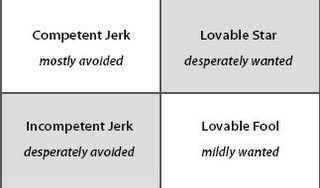


For more on this phenomenon and how it relates to professional social networks, see June 2005's Harvard Business Review, which includes the article "Competent Jerks, Lovable Fools, and the Creation of Social Networks," by Tiziana Casciaro and Miguel Sousa Lobo. (The artcle PDF is also available for free here.)

The authors describe a three-pronged approach to managing the tradeoffs of competent jerks and lovable fools: (1) manufacture liking, (2) leverage the likable, and (3) reform the jerks.

Under leveraging the likable, the authors describe how lovable fools can help organizations in the role of "affective hub." Joe Labianca (Professor of Organization & Management at Emory University) once told me a perfect story of an affective hub. A client of his was about to fire someone who was seemingly incompetent and/or lazy, until Joe's social network analysis revealed that this person was very much liked by and connected to every corner of the organization. So instead of firing him, the managers recognized this lovable fool as a key resource in winning widespread support for their new initiatives. Their ability to promote sustainable change improved dramatically as a result. Wow!

Thanks to my friend Todd Harris for the tip on this, and I also recommend you see Patti Anklam's post on this same article, as well as this nice review by Four Groups.

***

Taking a step back from this article, I'd say one thing that makes it so catchy is its use of "jerks" and "fools." The authors deliberately contradict the SNA tradition of focusing just on positive relationships, with dramatic effect.

Once again, this reminds me of Joe Labianca. He has been doing groundbreaking research in balancing the social network ledger by including negative relationships as much as positive relationships. As he explains in this thoughtful paper, negative relationships have received far too little attention. In fact, Joe suggests that negative relationships are more critical than positive ones in affecting key organizational attributes like performance.

Joe is certainly not the only one uncovering the dynamics of positive and negative social networks. Rob Cross and others have been doing related work on energy in organizations. But this post is too long already, so I'm going to save that discussion for later.
Email ThisBlogThis!Share to XShare to FacebookShare to Pinterest
Posted in | No comments
Newer Post Older Post Home

0 comments:

Post a Comment

Subscribe to: Post Comments (Atom)

Popular Posts

  • Happy, or at least healthy endings
    Yesterday was the 8th anniversary of my first Connectedness post , but it's been 3 years since I was even semi-active in this space. One...
  • Technology, sociology, and networks
    Behind the scenes at Connectedness , I have been talking to more computer scientists and fewer sociologists, relative to previous months. I ...
  • Social capital of twenty-first-century leaders, by Daniel Brass and David Krackhardt
    How do effective leaders manage relationships with their team members? Dan Brass and David Krackhardt put this question in context: "...
  • Structural equivalence: related tags in social bookmarking
    In my " Holy Trinity of Network Power ," structural equivalence is conceptually the most obscure. But practically speaking, it is ...
  • Weekend edition: SWMSNA seeks SWF
    It is the great tradition of science that our biggest discoveries often emerge from the smoldering ashes of our most disappointing failures....
  • Weekend Edition: Flesh-Eating Zombies
    As part of my final preparations for Sunbelt XXV , I watched a dramatic treatment of infection networks. 28 Days Later is the modern-day st...
  • What is My Network Value Worth?
    Pedro Domingos and Matt Richardson analyze the power of viral marketing in their paper, " Mining the Network Value of Customers ....
  • Sunbelt Goes to the Oscars
    I am dried off from the record-setting rains of Sunbelt XXV and ready to start reflecting... about this weekend's big Oscar hoo-ha (sor...
  • Searchable leadership networks bibliography
    Our new Link-to-Results site features a categorized searchable bibliography . Of all the pages on the site, this one has generated by far ...
  • Process networks in medical research
    I tripped over this interesting post by John Hagel : " Process networks in medical research ," in which he describes the Myelin Re...

Blog Archive

  • ►  2012 (1)
    • ►  June (1)
  • ►  2010 (3)
    • ►  June (2)
    • ►  May (1)
  • ►  2009 (22)
    • ►  December (1)
    • ►  September (2)
    • ►  August (2)
    • ►  July (1)
    • ►  June (5)
    • ►  May (4)
    • ►  March (2)
    • ►  February (4)
    • ►  January (1)
  • ►  2008 (36)
    • ►  December (3)
    • ►  November (2)
    • ►  October (1)
    • ►  September (6)
    • ►  August (4)
    • ►  July (2)
    • ►  June (8)
    • ►  May (4)
    • ►  April (3)
    • ►  February (1)
    • ►  January (2)
  • ►  2007 (42)
    • ►  December (1)
    • ►  November (1)
    • ►  October (2)
    • ►  September (6)
    • ►  August (6)
    • ►  July (5)
    • ►  June (8)
    • ►  May (4)
    • ►  March (3)
    • ►  February (1)
    • ►  January (5)
  • ►  2006 (63)
    • ►  December (4)
    • ►  October (2)
    • ►  September (2)
    • ►  August (3)
    • ►  July (7)
    • ►  June (10)
    • ►  May (10)
    • ►  April (4)
    • ►  March (8)
    • ►  February (6)
    • ►  January (7)
  • ▼  2005 (136)
    • ►  December (11)
    • ►  November (13)
    • ►  October (11)
    • ►  September (9)
    • ►  August (10)
    • ▼  July (10)
      • Fishing, Part 2
      • Fishing with a net, works (AKA my new favorite use...
      • Addictive network game
      • Battle of the Network Blogs
      • Personal Social Network Action Plan
      • The Economist on jerks, fools, and SNA
      • Social networks of jerks and fools
      • Social Network Information Gathering
      • Weekend Edition: Lance Rules
      • Process networks in medical research
    • ►  June (10)
    • ►  May (12)
    • ►  April (13)
    • ►  March (15)
    • ►  February (9)
    • ►  January (13)
  • ►  2004 (99)
    • ►  December (9)
    • ►  November (18)
    • ►  October (13)
    • ►  September (16)
    • ►  August (15)
    • ►  July (20)
    • ►  June (8)
Powered by Blogger.

About Me

Unknown
View my complete profile