Connecte Dness

  • Subscribe to our RSS feed.
  • Twitter
  • StumbleUpon
  • Reddit
  • Facebook
  • Digg

Tuesday, 27 June 2006

MarketingMonger podcast on SNA

Posted on 11:36 by Unknown
Eric Mattson called me from Sweden last week to continue his quest to conduct 1,000 podcast interviews. You can listen to the result here; I hope you enjoy. Eric and I had fun, anyway. Eric's post includes links to UCINET, InFlow, TeCFlow, and NetMiner. In hindsight I should have also given him the link to VisiblePath, which I described at length in the interview.

BTW, I won't be offended if you listen briefly and then get frustrated with my slow talking. If that happens, just check out this other podcast interview of me, which was accelerated by an audio compressor in order to present me in a more fast-talking style (with less about software tools and more about bridging and bonding forms of social capital).

Podcasting in general is something I am not keeping up on, with the singular exception of Tony Kahn, who produces and directs the Morning Stories podcast for NPR. It's a funny and touching look at everyday people.

This work is licensed under a Creative Commons Attribution-ShareAlike 2.5 License and is copyrighted (c) 2006 by Connective Associates except where otherwise noted.

Read More
Posted in | No comments

Monday, 26 June 2006

"The end of authorship" by John Updike

Posted on 08:04 by Unknown
Yesterday's NY Times Book Review features a back-page essay by John Updike, "The End of Authorship." It's a wonderful read, arguing that Kevin Kelly's prominently published dream of the all-encompassing hyperlinked universal book is more of a nightmare. (I have previously discussed Kelly's NY Times Magazine cover story from both sides, originally applauding it and later acknowledging some pointed criticism.)

Updike's essay is going to get beaten to death on the blogosphere over the next few days. Tune in to Technorati for a live view of the action. My favorite response to Updike so far comes from journalist Jason Chervokas.

I have no intention of beating up John Updike and would like to say a bit about why I agree (in my own way) with some of his most anti-Internet comments. In particular, Updike writes
"The economic repercussions of this paradise of freely flowing snippets are touched on [by Kelly] with a beguiling offhandedness, as a matter of course, a matter of an inexorable Marxist unfolding. As the current economic model disappears, Kelly writes, the 'basis of wealth' shifts to 'relationships, links, connection and sharing.' ...

"Has the electronic revolution pushed us so far down the path of celebrity ... that an author's works ... serve primarily as his or her ticket to the lecture platform?...

"Authors, if I understand present trends, will soon be like surrogate birth mothers, rented wombs in which a seed implanted by high-powered consultants is allowed to ripen and, after nine months, be dropped squalling into the marketplace.

"In imagining a huge, virtually infinite wordstream accessed by search engines and populated by teeming, promiscuous word snippets stripped of credited authorship, are we not depriving the written word of its old-fashioned function of, through such inventions as the written alphabet and the printing press, communication from one person to another — of, in short, accountability and intimacy?"
My favorite part of the essay is the amazing metaphor of "authors as surrogate mothers, rented wombs" owned by "high-powered consultants." Wow! The only issue I take with that disturbing image is the implication that consultants are more mercenary than authors. In support of Updike's main point (which applies equally well to all kinds of people, including both consultants and authors), see this post on viral marketing, which describes the alarming ease with which we rent out our creative wombs, as reported by this NY Times Magazine cover story.

Updike then claims that the Internet has stripped the written word of "accountability and intimacy." Like Updike, I do believe we are experiencing a substantial decline in accountability and intimacy. I also agree with Updike that the Internet has something to do with this decline--a contentious argument among sociologists that has recently captured front page headlines. But before we demonize the Internet and raise up our books, it's worth noting that books have also been criticized for alienating us from intimacy--ranging from Julia Cameron's argument that book-reading inhibits our inner artist to Leonard Shlain's thesis that literacy itself has fed a millenia-long hegemony of patriarchal intellectualism. Once again, Updike betrays his personal interest in books and authorship by ignoring their dark side.

On a final uplifting note, know that as long as brilliant writers like Updike write essays titled "The End of Authorship," we can rest assured that the institution of authorship remains secure. The nightmarish end of authorship will only truly happen when Updike gives a s**t what his Google rankings are--a lovely paradox I touched on recently in a post inspired by John English's The Economy of Prestige.

This work is licensed under a Creative Commons Attribution-ShareAlike 2.5 License and is copyrighted (c) 2006 by Connective Associates except where otherwise noted.

Read More
Posted in | No comments

Friday, 23 June 2006

Social isolation in America increasing dramatically

Posted on 07:26 by Unknown
The front page of today's Boston Globe announces "It's lonely out there." For substantially more detail on this sobering topic, see "Social Isolation in America," published today by Miller McPherson, Lynn Smith-Lovin, and Matthew Brashears in the American Sociological Review. The paper states:
The number of people who have someone to talk to about matters that are important to them has declined dramatically. [Between 1985 and 2004]... we have gone from a quarter of the American population being isolated ... to almost half of the population falling into that category.
The paper later suggests, "Shifts in work, geographic, and recreational patterns may have combined to create a larger demarcation between a smaller core of very close confidant ties and a much larger array of less interconnected, more geographically dispersed, more unidimensional relationships." It then concludes:
Whatever the reason, it appears that Americans are connected far less tightly now than they were 19 years ago.
See also today's Washington Post for similar news coverage.

While many sociologists are shocked that American's social connectedness may be even worse off than Robert Putnam suggested in the landmark Bowling Alone, others argue that the data are not at all clear and that dramatic increase of Internet socialization casts doubt on the dire conclusions of "Social Isolation in America." See "The Strength of Internet Ties" by Jeffrey Boase, John Horrigan, Barry Wellman, and Lee Rainie (on behalf of the Pew Internet & American Life Project), which specifically challenges McPherson et al for being too narrow in their definition of "close ties":
There is more to being “very close” to a person than being a confidant discussing important matters. Having frequent intimate contact — whether in person or online — and providing help to each other clearly play roles.
Long ago I put my own two cents into this debate: I share Putnam's concern and furthermore find it striking that amidst so much decline in community, two venues where American socializing is actually increasing are self-help groups and the Internet. I call this the "Cross Talk Crisis"; Barry Wellman more optimistically calls it "Networked Individualism."

This work is licensed under a Creative Commons Attribution-ShareAlike 2.5 License and is copyrighted (c) 2006 by Connective Associates except where otherwise noted.
Read More
Posted in | No comments

Thursday, 22 June 2006

Don't let all the pretty days get by

Posted on 06:55 by Unknown
Today is the second anniversary of Connectedness. Sadly, it also marks the end of our two-week party on the "Blogs of Note" list, so our birthday celebration has a few empty seats, relatively speaking.

Even so, I have a lot to be happy about. For example, I recently discovered an up-and-coming novelist by the name of Bruce Hoppe. His debut, Don't Let All the Pretty Days Get By, reminds me to enjoy the moment.

To learn more about this "post-modern romp through the new West," you will want to be very clear on the difference between me and my namesake at Back-to-One Books.

This work is licensed under a Creative Commons Attribution-ShareAlike 2.5 License and is copyrighted (c) 2006 by Connective Associates except where otherwise noted.
Read More
Posted in | No comments

Tuesday, 20 June 2006

Enterprise 2.0 and the dawn of emergent collaboration

Posted on 06:23 by Unknown
Andrew McAfee heralds "Enterprise 2.0: the dawn of emergent collaboration" in the Spring 2006 MIT Sloan Management Review. It's a good overview of how businesses can make the most of blogs, wikis, and RSS web technologies. I recommend you check it out--despite the article's pretentious and misleading title.

The good part of the article is McAfee's list of six components of Enterprise 2.0, which conveniently yields the acronymn SLATES:
  • Search--keyword search is becoming increasingly powerful
  • Links--density of links is increasing, providing ever richer context
  • Authoring--more and more people are creating both content and links
  • Tags--emergent categories make content easier to navigate
  • Extensions--generate useful recommendations based on other people like you
  • Signals--RSS and news aggregators protect users from information overload
My main complaint about the article is how McAfee associates SLATES with "the dawn of emergent collaboration." People have been practicing emergent collaboration ever since we dropped out of the trees and learned how to walk and make tools. See Marcel Mauss' 1924 research on "functions of exchange in archaic societies" for (pre-) historic background and Mary Parker Follett for organizational application of similar principles, also written in the 1920s.

The dawn that we are witnessing is not one of collaboration. Instead, we are witnessing the dawn (or more precisely, return) of user-driven technical invention. To put that in context, consider this quote from the outstanding 1995 book What Machines Can't Do by Robert Thomas (formerly a professor at MIT Sloan and now writing excellent research for Accenture's Institute of High Performance Business), who said (in 1995):
"The separation of technology design and implementation in time and space dramatically reduces the opportunities for meaningful “user” participation in the change process…. Technology designers have little incentive to solicit input from those who are the object of change. As a result, new technology frequently confronts the rest of the organization as an exogenous force—one that can be countered only through overt political action."
The 1995 separation between technology design and implementation has visibly dissolved in McAfee's 2006 world of SLATES--and I think that is pretty exciting... Rather than type any unseemly exclamation points at this point, I refer you to this podcast where you can hear me panting about this revolution in the making.

Now all we need is a better descriptor than the way-overused "2.0" suffix.

This work is licensed under a Creative Commons Attribution-ShareAlike 2.5 License and is copyrighted (c) 2006 by Connective Associates except where otherwise noted.
Read More
Posted in | No comments

Friday, 16 June 2006

Blog network analysis

Posted on 07:58 by Unknown
Connectedness is approaching the end of its ten-day reign on the "Blogs of Note" list. It's been fun getting all the extra traffic and comments from newcomers to the world of social network analysis. Anybody wondering what I am talking about may appreciate jumping to this welcome post.

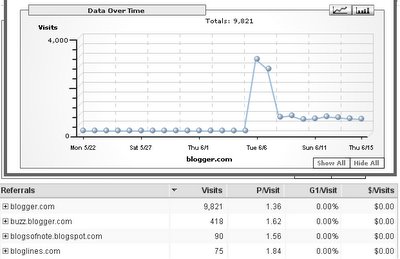
I have kept a close eye on my traffic since 06-06-06, and the statistics are dramatic. The chart below shows how the blogger.com home page went from nowhere to being 95% of my traffic overnight.
The thing that has really puzzled me about the above chart is how being at the top of the ten blogs of note (as Connectedness was for 24 hours starting 9am PDT Tue 6/6, and as Farmgirl Fare is right now) is so different from being anywhere else on the list.

Are web surfers so mindless that we nearly always click on the top of the list, no matter what appears below it?

I recovered some of my faith in web-surfer intelligence and deepened my appreciation for the complexity of "blog network analysis" when I realized that not everyone sees the same thing when they point their browser at http://blogger.com. When I logged off the Blogger.com system and looked at it from a newcomer's perspective, the top ten "Blogs of Note" went away and I got this subscription screen instead, which only lists today's singular blog of note:
Moral of the story: It's easy to jump to the wrong conclusions from a network analysis if you forget that we (even websites) personalize the referrals that we share depending on who is asking.

This work is licensed under a Creative Commons Attribution-ShareAlike 2.5 License and is copyrighted (c) 2006 by Connective Associates except where otherwise noted.

Read More
Posted in | No comments

Tuesday, 13 June 2006

Today's WSJ on why companies need to forget the team approach to creativity

Posted on 12:20 by Unknown
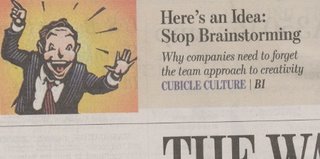
The front page of today's Wall Street Journal features the headline, "Why companies need to forget the team approach to creativity."

It's a great article by Jared Sandberg that is much more about brainstorming than it is about teams and creativity. Brainstorming puts all the members of a team into one room at the same time in an attempt to "be creative." Compare that to Ron Burt's work, which shows the kind of team approach that actually does promote creativity.

This work is licensed under a Creative Commons Attribution-ShareAlike 2.5 License and is copyrighted (c) 2006 by Connective Associates except where otherwise noted.

Read More
Posted in | No comments
Newer Posts Older Posts Home
Subscribe to: Posts (Atom)

Popular Posts

  • Happy, or at least healthy endings
    Yesterday was the 8th anniversary of my first Connectedness post , but it's been 3 years since I was even semi-active in this space. One...
  • Technology, sociology, and networks
    Behind the scenes at Connectedness , I have been talking to more computer scientists and fewer sociologists, relative to previous months. I ...
  • Social capital of twenty-first-century leaders, by Daniel Brass and David Krackhardt
    How do effective leaders manage relationships with their team members? Dan Brass and David Krackhardt put this question in context: "...
  • Weekend edition: SWMSNA seeks SWF
    It is the great tradition of science that our biggest discoveries often emerge from the smoldering ashes of our most disappointing failures....
  • Structural equivalence: related tags in social bookmarking
    In my " Holy Trinity of Network Power ," structural equivalence is conceptually the most obscure. But practically speaking, it is ...
  • Weekend Edition: Flesh-Eating Zombies
    As part of my final preparations for Sunbelt XXV , I watched a dramatic treatment of infection networks. 28 Days Later is the modern-day st...
  • What is My Network Value Worth?
    Pedro Domingos and Matt Richardson analyze the power of viral marketing in their paper, " Mining the Network Value of Customers ....
  • Sunbelt Goes to the Oscars
    I am dried off from the record-setting rains of Sunbelt XXV and ready to start reflecting... about this weekend's big Oscar hoo-ha (sor...
  • Searchable leadership networks bibliography
    Our new Link-to-Results site features a categorized searchable bibliography . Of all the pages on the site, this one has generated by far ...
  • Process networks in medical research
    I tripped over this interesting post by John Hagel : " Process networks in medical research ," in which he describes the Myelin Re...

Blog Archive

  • ▼  2012 (1)
    • ▼  June (1)
      • Happy, or at least healthy endings
  • ►  2010 (3)
    • ►  June (2)
    • ►  May (1)
  • ►  2009 (22)
    • ►  December (1)
    • ►  September (2)
    • ►  August (2)
    • ►  July (1)
    • ►  June (5)
    • ►  May (4)
    • ►  March (2)
    • ►  February (4)
    • ►  January (1)
  • ►  2008 (36)
    • ►  December (3)
    • ►  November (2)
    • ►  October (1)
    • ►  September (6)
    • ►  August (4)
    • ►  July (2)
    • ►  June (8)
    • ►  May (4)
    • ►  April (3)
    • ►  February (1)
    • ►  January (2)
  • ►  2007 (42)
    • ►  December (1)
    • ►  November (1)
    • ►  October (2)
    • ►  September (6)
    • ►  August (6)
    • ►  July (5)
    • ►  June (8)
    • ►  May (4)
    • ►  March (3)
    • ►  February (1)
    • ►  January (5)
  • ►  2006 (63)
    • ►  December (4)
    • ►  October (2)
    • ►  September (2)
    • ►  August (3)
    • ►  July (7)
    • ►  June (10)
    • ►  May (10)
    • ►  April (4)
    • ►  March (8)
    • ►  February (6)
    • ►  January (7)
  • ►  2005 (136)
    • ►  December (11)
    • ►  November (13)
    • ►  October (11)
    • ►  September (9)
    • ►  August (10)
    • ►  July (10)
    • ►  June (10)
    • ►  May (12)
    • ►  April (13)
    • ►  March (15)
    • ►  February (9)
    • ►  January (13)
  • ►  2004 (99)
    • ►  December (9)
    • ►  November (18)
    • ►  October (13)
    • ►  September (16)
    • ►  August (15)
    • ►  July (20)
    • ►  June (8)
Powered by Blogger.

About Me

Unknown
View my complete profile